


The best company for the Inca Jungle Trek Peru
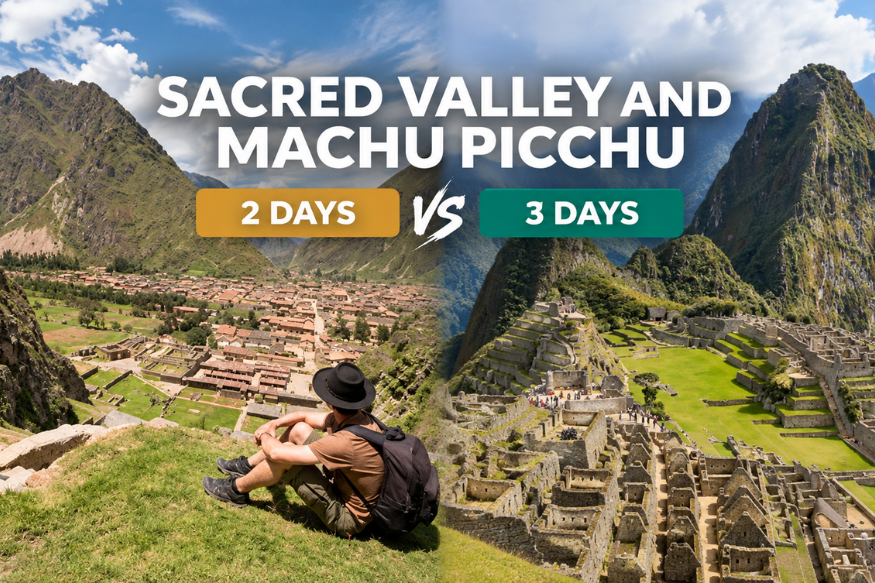
If you are planning to combine two of the most important destinations in the Cusco region, you may be wondering whether Sacred Valley and Machu Picchu in 2 days vs 3 days is the better itinerary for your trip.
The good news is that you do not necessarily need three days.
A 2-day Sacred Valley and Machu Picchu itinerary can work very well if you want to visit key Sacred Valley attractions, continue to Ollantaytambo, take the train to Aguas Calientes and visit Machu Picchu the following day.
A 3-day itinerary, on the other hand, gives you more flexibility. You can dedicate more time to the Sacred Valley, spend additional time in Aguas Calientes, or organize your Machu Picchu visit without concentrating as much travel and sightseeing into two days.
The main difference is therefore not whether you can see Machu Picchu properly.
It is how much of the Sacred Valley you want to experience and how fast you want to travel.
| 2 Days | 3 Days | |
|---|---|---|
| Sacred Valley | Day 1 | More time available |
| Aguas Calientes | 1 night | 1–2 nights depending on itinerary |
| Machu Picchu | Day 2 | Usually Day 2 or 3 |
| Travel pace | Efficient | More relaxed |
| Best for | Short Peru itineraries | Travelers with more time |
| Extra flexibility | Limited | Higher |
| Hotel nights | Usually 1 | Usually 2 |
| Time required | 2 days / 1 night | 3 days / 2 nights |
Let’s compare both options in detail.
Can You Visit the Sacred Valley and Machu Picchu in 2 Days?
Yes. Two days are enough to combine the Sacred Valley and Machu Picchu when the itinerary is organized efficiently.
The geography of the route makes this possible.
Ollantaytambo is located in the Sacred Valley and is also one of the principal departure points for trains toward Aguas Calientes.
Instead of exploring the Sacred Valley and returning to Cusco at the end of the day, you can continue your journey toward Machu Picchu.
A typical route looks like this:
Day 1: Cusco → Sacred Valley → Ollantaytambo → Train → Aguas Calientes
Day 2: Aguas Calientes → Machu Picchu → Train → Ollantaytambo → Cusco
This is essentially how a Sacred Valley and Machu Picchu 2 Days tour makes efficient use of the route between Cusco and Machu Picchu.
You are not trying to squeeze two completely separate destinations into two unrelated day trips.
Instead, the Sacred Valley becomes part of your journey toward Machu Picchu.
What Is a 2-Day Sacred Valley and Machu Picchu Trip Like?
A two-day itinerary moves relatively quickly, but it can cover a lot without requiring you to return to Cusco between destinations.
Day 1: Sacred Valley to Aguas Calientes
Your journey begins in Cusco and continues into the Sacred Valley.
Depending on your itinerary, you may visit places such as Chinchero, Moray, Maras, Urubamba and Ollantaytambo.
The Sacred Valley contains numerous archaeological sites, traditional communities and landscapes, so a two-day itinerary usually focuses on selected highlights rather than attempting to see everything.
After exploring the valley, you continue toward Ollantaytambo.
From there, you board the train to Aguas Calientes.
Once you arrive, you check into your hotel and spend the night near Machu Picchu.
Day 2: Machu Picchu and Return to Cusco
The second day is dedicated primarily to Machu Picchu.
From Aguas Calientes, you travel toward the archaeological site and enter according to the time and circuit assigned to your ticket.
After completing your visit, you return to Aguas Calientes.
Later, you take your train toward Ollantaytambo and continue by road to Cusco.
This means you can experience both the Sacred Valley and Machu Picchu while using only two days of your Peru itinerary.
What Are the Advantages of the 2-Day Itinerary?
The biggest advantage is efficiency.
Many travelers visiting Peru have limited time and want to experience Cusco, the Sacred Valley, Machu Picchu, Rainbow Mountain and other destinations during the same trip.
Using two days for the Sacred Valley and Machu Picchu leaves more room for those additional experiences.
Another advantage is the route itself.
If you visited the Sacred Valley as a traditional day trip, you would normally need to return toward Cusco afterward.
When combining the valley with Machu Picchu, you can instead continue from Ollantaytambo toward Aguas Calientes.
This avoids unnecessary backtracking.
A two-day itinerary is particularly useful if:
- You have limited time in Cusco.
- You want to visit both the Sacred Valley and Machu Picchu.
- You are comfortable with a structured itinerary.
- You do not need a full additional day in the Sacred Valley.
- You want to spend one night in Aguas Calientes.
- You want to save other days for additional destinations.
For many first-time visitors, this is one of the most practical ways to combine the two destinations.
What Are the Disadvantages of Doing It in 2 Days?
The main limitation is time.
The Sacred Valley is not a single attraction.
It is a large region containing archaeological sites, villages, agricultural landscapes and living Andean communities.
Trying to see every major attraction before catching a train would create an unnecessarily rushed schedule.
A good two-day itinerary therefore requires prioritization.
You may need to choose which Sacred Valley attractions matter most rather than attempting to visit everything.
Your first day also includes several different activities: sightseeing, road transportation and a train journey.
Travelers who enjoy slower mornings, long lunches or spontaneous stops may prefer three days.
How Does a 3-Day Sacred Valley and Machu Picchu Trip Work?
A three-day itinerary gives you more freedom to decide where you want the extra time.
There is no single mandatory structure.
One possible itinerary is:
Day 1: Explore the Sacred Valley
Travel from Cusco into the Sacred Valley and spend the day visiting archaeological sites and communities.
Depending on your route, you can explore destinations such as Chinchero, Moray, Maras, Urubamba and Ollantaytambo.
You can then stay overnight in the Sacred Valley or continue toward Aguas Calientes depending on your train schedule.
Day 2: Continue to Aguas Calientes
If you stayed in the Sacred Valley, you can spend additional time exploring before taking the train toward Aguas Calientes.
Once there, check into your hotel and enjoy the rest of the day in Machu Picchu Pueblo.
Day 3: Visit Machu Picchu
Travel from Aguas Calientes to Machu Picchu and complete your visit according to your scheduled entrance.
Afterward, return to Aguas Calientes, board your train and continue toward Cusco.
Another possibility is to reach Aguas Calientes on Day 1 or Day 2, visit Machu Picchu earlier and use the additional day differently.
That flexibility is one of the main advantages of choosing three days.
Why Choose 3 Days Instead of 2?
Three days can be worthwhile when you do not want your trip to feel like a sequence of transportation connections.
The extra day allows you to slow the journey down.
You may have more time to:
- Explore additional Sacred Valley attractions.
- Spend more time in Ollantaytambo.
- Stay overnight in the Sacred Valley.
- Enjoy Aguas Calientes without rushing.
- Separate sightseeing days from major transportation days.
- Build more flexibility around your train and entrance schedules.
The additional day can be especially valuable for families, older travelers and anyone who prefers slower travel.
However, this does not mean everyone needs three days.
If your itinerary is limited, adding a third day may provide less value than using that day for another destination around Cusco.
Sacred Valley in 2 Days vs 3 Days: How Much More Do You See?
This depends entirely on how the third day is used.
A common misconception is that choosing three days automatically means spending substantially more time inside Machu Picchu.
That is not necessarily the case.
Machu Picchu visits follow designated circuits and entrance times.
The extra day usually provides more time around the journey, particularly in the Sacred Valley or Aguas Calientes.
This is important because the Sacred Valley contains far more than one archaeological site.
With additional time, you may be able to explore the region at a slower pace instead of focusing only on the most practical stops along the route toward Ollantaytambo.
Which Sacred Valley Attractions Can You Visit?
The Sacred Valley offers several important destinations, and the exact combination depends on the itinerary you choose.
Chinchero
Chinchero is known for its Andean traditions, archaeological remains, agricultural terraces and textile culture.
It is often one of the first stops when traveling from Cusco toward the Sacred Valley.
Moray
Moray is famous for its circular agricultural terraces.
The unusual design of the site makes it one of the most distinctive archaeological attractions in the region.
Maras Salt Mines
The salt mines of Maras contain thousands of salt pools arranged along the mountainside.
They offer a very different experience from the archaeological sites found elsewhere in the valley.
Urubamba
Urubamba sits in the heart of the Sacred Valley and is commonly used as a lunch or accommodation stop.
Ollantaytambo
Ollantaytambo is particularly important when combining the Sacred Valley with Machu Picchu.
The town contains an impressive archaeological complex and preserves a remarkable Inca urban layout.
It is also an important transportation hub because trains toward Aguas Calientes depart from the area.
This makes Ollantaytambo the natural connection between Sacred Valley sightseeing and the journey to Machu Picchu.
Should You Stay in Ollantaytambo or Aguas Calientes?
Both can make sense depending on your itinerary.
Staying in Ollantaytambo allows you to spend more time in the Sacred Valley before taking the train the following day.
Staying in Aguas Calientes places you much closer to Machu Picchu before your entrance.
For a compact two-day itinerary, continuing to Aguas Calientes on Day 1 is generally more efficient because you wake up near Machu Picchu on Day 2.
For a three-day itinerary, staying in Ollantaytambo can become more practical because you have enough time to separate the Sacred Valley exploration from the train journey.
The right choice depends on where you want to spend the additional time.
Is It Better to Stay Overnight in Aguas Calientes Before Machu Picchu?
For many travelers, yes.
Sleeping in Aguas Calientes means you do not need to travel from Cusco or the Sacred Valley immediately before your Machu Picchu visit.
You wake up close to the archaeological site and can organize the morning around your scheduled entrance.
Aguas Calientes also gives you access to restaurants, hotels, markets and other traveler services.
You do not need a full day to explore the town, but an overnight stay can make the overall Machu Picchu journey considerably easier.
Which Option Is Better for First-Time Visitors?
Both can work well for first-time travelers.
If your first trip to Peru includes many destinations, two days provide an efficient introduction to both the Sacred Valley and Machu Picchu.
You experience selected Sacred Valley highlights, travel by train through the Andes, spend a night in Aguas Calientes and visit Machu Picchu the following day.
If your itinerary has more flexibility, three days allow you to experience the region more slowly.
The question is therefore not:
“Can I see everything in two days?”
The Sacred Valley contains too much to see everything in a short visit.
A more useful question is:
“Can I see the main places I care about in two days?”
For many travelers, the answer is yes.
Which Option Is Better for Families?
Families may appreciate the slower pace of a three-day itinerary.
On a two-day trip, the first day combines Sacred Valley sightseeing with the train journey to Aguas Calientes.
That schedule is manageable, but younger children may become tired.
With three days, you can separate some of those activities and reduce the amount of movement required on a single day.
However, families accustomed to active itineraries can still complete the two-day journey comfortably.
The ages of the children and your normal travel pace matter more than the number of days itself.
Which Option Is Better for Older Travelers?
Three days can provide additional comfort because it reduces the need to combine several activities and transportation stages in one day.
However, traveling to Machu Picchu by train does not require completing a multi-day hike.
A well-organized two-day itinerary can therefore still be suitable for many older travelers.
If avoiding rushed connections is important, the additional day may be worthwhile.
What If You Only Want to Visit Machu Picchu?
If the Sacred Valley is not a priority, you do not need to include it simply because it is located along the route.
You can travel directly toward Machu Picchu instead.
Travelers with very limited time can take a Machu Picchu day trip from Cusco and complete the journey in one day.
Another option is a Machu Picchu Tour 2 Days, which allows you to travel to Aguas Calientes on the first day and visit Machu Picchu the following day.
The Sacred Valley combination makes the most sense when you genuinely want to experience both destinations.
2-Day Sacred Valley and Machu Picchu: Pros and Cons
Pros
- Efficient use of your time.
- Combines two major destinations.
- Avoids returning to Cusco after the Sacred Valley.
- Includes an overnight stay in Aguas Calientes.
- Leaves more days available for other experiences.
- Works well for travelers with short itineraries.
Cons
- Faster travel pace.
- Limited time at some Sacred Valley attractions.
- Requires good coordination with the train schedule.
- Day 1 can be relatively busy.
- Less room for spontaneous stops.
3-Day Sacred Valley and Machu Picchu: Pros and Cons
Pros
- More relaxed pace.
- More time in the Sacred Valley.
- Greater itinerary flexibility.
- Possibility of staying in Ollantaytambo.
- More time in Aguas Calientes if desired.
- Easier to separate sightseeing from transportation.
Cons
- Requires another day of your Peru itinerary.
- Usually involves an additional hotel night.
- Can increase the overall trip cost.
- The extra day is not essential for travelers interested primarily in Machu Picchu.
Sacred Valley and Machu Picchu: 2 Days vs 3 Days Comparison
| Factor | 2 Days | 3 Days |
|---|---|---|
| Overall pace | Faster | More relaxed |
| Sacred Valley time | Selected highlights | More exploration possible |
| Machu Picchu visit | Yes | Yes |
| Aguas Calientes overnight | Usually 1 night | 1–2 nights depending on plan |
| Ollantaytambo overnight | Usually not necessary | Possible |
| Best for short itineraries | Excellent | Requires more time |
| Families | Possible | More flexible |
| Transportation | More concentrated | Easier to divide |
| Flexibility | Moderate | Higher |
| Additional hotel night | No | Usually yes |
Is 2 Days Enough for the Sacred Valley and Machu Picchu?
Yes, two days can be enough when your goal is to experience selected Sacred Valley highlights and visit Machu Picchu efficiently.
You will not explore every corner of the Sacred Valley.
But that is not necessary for a rewarding first visit.
The key is choosing an itinerary that uses Ollantaytambo as the connection between the Sacred Valley and Aguas Calientes rather than returning to Cusco.
This makes a 2-day Sacred Valley and Machu Picchu itinerary particularly efficient.
Is 3 Days Worth It?
Three days can be worth it if you have enough time and prefer depth over efficiency.
The additional day is particularly useful when you want to spend more time exploring the Sacred Valley rather than simply passing through its main attractions on the way to Machu Picchu.
It also allows you to build a more relaxed schedule around Ollantaytambo, Aguas Calientes and your train connections.
But you should not assume that three days are automatically necessary.
For travelers with a short Peru itinerary, that third day may be better spent exploring another part of Cusco.
What About the Train to Machu Picchu?
Whether you choose two or three days, the train is an important part of the journey.
Ollantaytambo is one of the principal gateways for travelers continuing toward Aguas Calientes.
The route follows the Urubamba River as the Andean environment gradually changes toward the cloud forest surrounding Machu Picchu.
Your train schedule can influence how much of the Sacred Valley you can visit before continuing toward Aguas Calientes.
For this reason, Machu Picchu entrance availability and train schedules should be considered when building the itinerary, rather than planning each component independently.
If you are deciding between different train-based itineraries, you can also compare Machu Picchu by train in one day vs two days.
How Many Days Should You Spend in the Cusco Region?
Your Sacred Valley and Machu Picchu itinerary is only one part of a larger Cusco trip.
Travelers frequently want to include:
- Cusco historic center.
- Sacred Valley.
- Machu Picchu.
- Rainbow Mountain.
- Humantay Lake.
- Nearby archaeological sites.
- Multi-day treks.
If you want to experience several of these destinations, spending five to seven days or more in the Cusco region can give you considerably more flexibility.
This is why saving a day with the two-day Sacred Valley and Machu Picchu combination can be valuable.
If you are still deciding how much time to allocate, read our guide on how many days you need for Machu Picchu.
2 Days or 3 Days: Which Should You Choose?
Choose 2 days if:
- Your Peru itinerary is limited.
- You want to see the main Sacred Valley highlights.
- You are comfortable with an active first day.
- You want to spend one night in Aguas Calientes.
- You want to visit other destinations around Cusco.
- Efficiency is important.
Choose 3 days if:
- You prefer a slower pace.
- You want more time in the Sacred Valley.
- You want to spend more time in Ollantaytambo.
- You are traveling with children or older relatives.
- You prefer additional flexibility around trains and accommodation.
- You do not mind using an extra day of your Peru itinerary.
There is no universal answer.
The better itinerary is the one that matches your available time and travel pace.
Frequently Asked Questions
Can you do the Sacred Valley and Machu Picchu in 2 days?
Yes. You can explore selected Sacred Valley attractions on Day 1, continue from Ollantaytambo by train to Aguas Calientes, stay overnight and visit Machu Picchu on Day 2.
Is 2 days enough for Machu Picchu and the Sacred Valley?
Two days are enough for travelers who want to see key Sacred Valley attractions and complete a standard Machu Picchu visit. You will need to prioritize the Sacred Valley sites you want to see rather than trying to visit everything.
Is 3 days better for the Sacred Valley and Machu Picchu?
Three days provide more time and flexibility, particularly in the Sacred Valley. Whether that extra day is worthwhile depends on your overall Peru itinerary and preferred travel pace.
Should I stay in Ollantaytambo or Aguas Calientes?
Aguas Calientes is more convenient when you want to wake up close to Machu Picchu. Ollantaytambo can be useful on a three-day itinerary when you want additional time in the Sacred Valley before taking the train.
Can I go directly from the Sacred Valley to Machu Picchu?
You can continue from the Sacred Valley toward Aguas Calientes by taking a train from the Ollantaytambo area. This is what makes combining the Sacred Valley and Machu Picchu particularly efficient.
How many nights do I need in Aguas Calientes?
For many travelers, one night is enough. You can arrive from Ollantaytambo, stay overnight, visit Machu Picchu the following day and then return toward Cusco.
Do I need three days to see Machu Picchu properly?
No. The additional day is generally useful for the Sacred Valley, Aguas Calientes or overall travel flexibility rather than because a standard Machu Picchu visit itself requires three days.
Is the Sacred Valley worth visiting before Machu Picchu?
For travelers interested in Inca history, Andean culture, archaeological sites and landscapes beyond Machu Picchu, the Sacred Valley adds substantial context to the journey. Its location also makes it practical to combine with the train route toward Aguas Calientes.
Plan Your Sacred Valley and Machu Picchu Trip
The choice between Sacred Valley and Machu Picchu in 2 days vs 3 days ultimately depends on how much time you have and how quickly you like to travel.
If efficiency is your priority, a Sacred Valley and Machu Picchu 2 Days tour allows you to explore key destinations in the Sacred Valley, continue by train to Aguas Calientes and visit Machu Picchu the following day.
If you have an additional day, you can slow the journey down, spend more time exploring the Sacred Valley and create more flexibility around Ollantaytambo, Aguas Calientes and your Machu Picchu entrance.
At SAP ADVENTURES, we organize Machu Picchu itineraries around your available time and the experiences you want to prioritize in the Cusco region.
You do not need to fit every Sacred Valley attraction into one trip.
The goal is to see the places that matter most to you while leaving enough time to enjoy the journey to Machu Picchu.